Socio-Economic Development

Progress in economic and social terms

Socio-Economic Development

Infrastructure as a driver of economic development

Hard and soft infrastructure are the backbone of the global economy. They

  • enable efficient trade,
  • create and connect people to job opportunities
  • and open access to new markets.

Infrastructure spending is an important tool for economic stimulus and growth, as well as a key lever for poverty alleviation and social inclusion. For instance, a 1-percent increase in physical infrastructure assets, is estimated to boost GDP growth by as much as 1-2 percent – and additionally contributes to growth in other sectors. This is much higher than other forms of public spending.

If infrastructure is planned, constructed and managed in a sustainable manner there is additional potential in economic growth and social as well as economic inclusion. Furthermore, sustainable infrastructure is deliberately build to withstand natural disasters and other shocks making sustainable infrastructure projects especially feasible in face of climate change and political uncertanties.

Higher Investment in Sustainable Infrastructure Creates More Benefits for the Economy, Environment and Society:

Energy infrastructure – Enabler of economic and social growth:

A reliable and low-cost energy and electricity infrastructure is a pre-condition for investments, innovations, and new industries that foster inclusion, growth, and the generation of new jobs.

The access of businesses to energy, especially electricity, increases their productivity and profitability, enables them to have longer opening hours, enhances security and creates the opportunity to open businesses in rural areas. That makes electrification a core driver in the reduction of regional disparities and inclusive development.

Renewable energy plays role of utmost importance in realizing the full potential of energy infrastructure for economic benefits: each $1 million invested in renewable energy creates around seven new full-time jobs – five more than the same investment in fossil fuels.

Renewable energy infrastructure is not only a key driver of social and economic development but also essential for achieving a climate-neutral future. Consequently, accelerating its expansion is imperative.

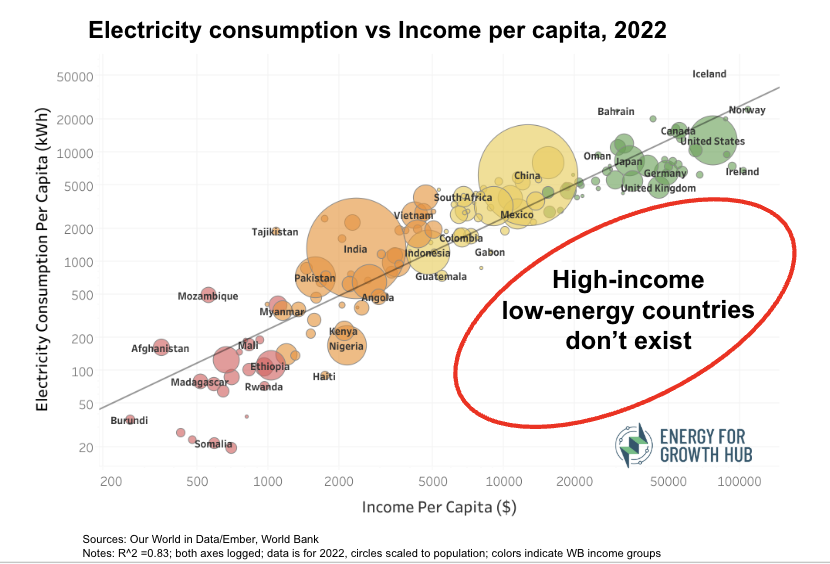
Electricity consumption vs. Income per capita, 2022

The graphic was kindly provided by the Energy for Growth Hub. Please click here for their blog post on why High-Income Low-Energy Countries Don’t Exist.

Transport infrastructure – Driver of economic activity and equal access to services:

Accessible transport infrastructure is a fundamental component to increase connectivity in and between regions. But safe and reliable transport infrastructure not only connects people to essential services such as healthcare or education and to new job opportunities, it also increases women’s access to the labour market. Furthermore, transport infrastructure enables the exchange of goods and services between countries, contributing to economic growth through enhanced opportunities for trading on a regional and supraregional level. 

On the flipside, sustainable transport infrastructure faces various risks that need to be considered in project planning, with high enviromental and climate change-related risks being among the most significant.

Digital Infrastructure – Bridging Economic Opportunities and Social Inclusion: 

Digital infrastructure is a condition to enable the transition to an information society in an integrated digital economy. Increased digital infrastructure development has created new opportunities for countries to accelerate economic growth, connect citizens to jobs and services as well as increase local value creation. Increased broadband penetration, for example, can increase GDP by strengthening connections between goods, people, markets and jobs. In case of natural disasters and other shocks digital infrastructure can also enhances community resilience by providing access to information, services and employment opportunities when local physical infrastructure may be inoperable. Building on these benefits, Digital Public Infrastructure can further support sustainable development by enabling data-driven approaches that promote environmental sustainability while fostering inclusive socio-economic development.

Interested in learning more?

Sustainable Development Bond Framework

By: Asian Infrastructure Investment Bank

Read this official report to learn more about Development Bonds and how they help states and governments build sustainable and resilient infrastructure.

Overview of selected sustainable infrastructure standards and norms

By: OECD

This annex provides an initial stock take of sustainable infrastructure initiatives, to raise awareness amongst policymakers, infrastructure planners and decision-makers on the variety of tools, instruments and techniques available to help them better integrate the 2030 Agenda for Sustainable Development as well as climate and development goals into their strategic infrastructure planning and decision-making.

What is sustainable Infrastructure? A Framework to Guide Sustainability Across the Project Cycle

By: Inter-American Development Bank

This document presents a framework for both public and private sectors to support planning, designing, and financing of infrastructure that is economically, financially, socially, environmentally, and institutionally sustainable.

The International Good Practice Principles for Sustainable Infrastructure

By: UNEP

This document and its accompanying case studies provide a framework for integrated approaches to sustainable infrastructure. The report presents ten good practice principles, from backing resource efficiency and circularity to fiscal innovation to comprehensive lifecycle assessments of sustainability.

Relevant sustainability tools